bcm241
Throughout our research within our digital artefacts BCM241 students will conduct autoethnographic research. This entails understanding personal and non-personal engagement with others, of which we can explore, learn from and engage with. Therefore the process of engaging with my peers and reviewing their pitches enables a deeper understanding as well as a learning experience within my own work.
“Students are more motivated to engage with and use feedback when the immediate utility of that feedback is clear”. (Moore & Tether, 2013 p197) This statement relates to the performance of our comments. The feedback that is given needs to be useful and informative of what can be done better, so that the receiver can act upon and learn from the feedback given.
Pitch 1
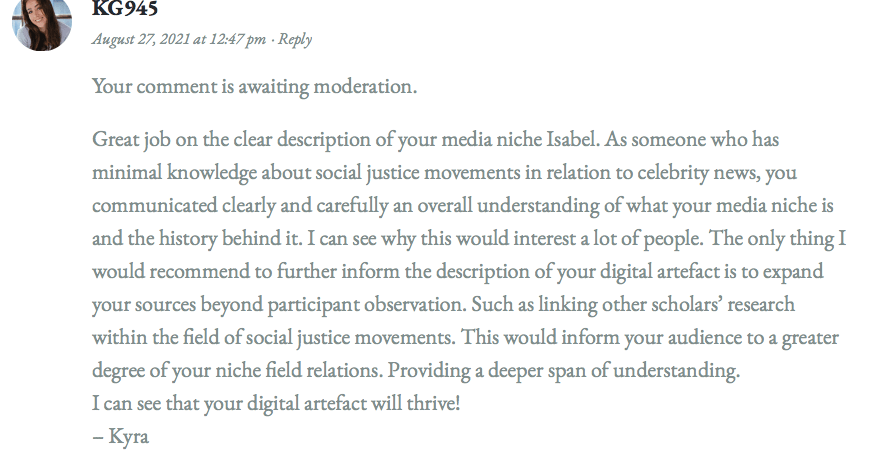
Isabel’s DA is interested in combining her passions of social justice movements and celebrity news stories through the use of tik tok videos. My engagement as a feedback member enables a reflection of what she did well and what can be added for improvement. Therefore my comment on her pitch congratulated her on the great description of the media niche, however stating that adding more sources such as research articles on social justice movements could help expand her audience’s understanding of the specialty niche to a greater degree.
https://justmundane101.wordpress.com
Pitch 2
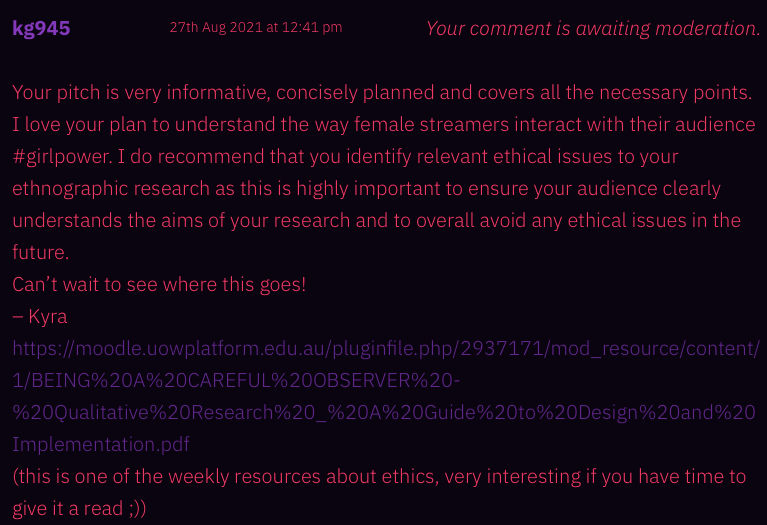
Isabeau’s DA delves into how female video game streamers on twitch are treated within the industry. My feedback on this pitch was mostly positive as she concisely communicated every aspect of her DA. although not mentioning any ethical issues that can arise within ethnographic research. Reflecting on my comment now, I see that I could have informed her of the ethics to be aware of whilst conducting research in a public niche. Such key points being knowledge, truth and avoidance error. The researcher needs to promote truth in order to minimize error” (Resnik, 2020)
Pitch 3
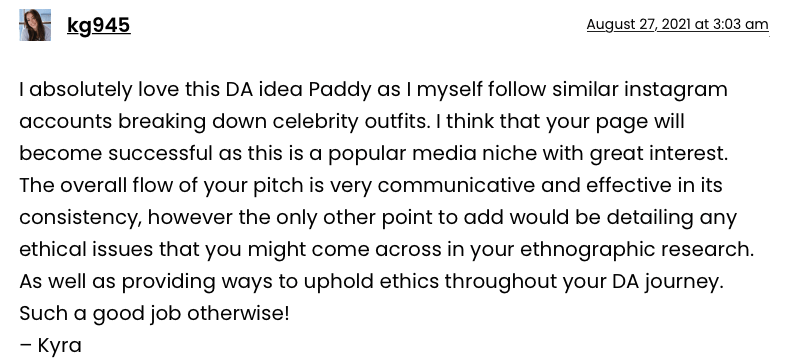
Lastly Paddy’s DA looks into cratings posts for his instagram page which break down outfits worn by celebrities within the hiphop and rap community. He too did a great job in communicating his DA however left out the importance of ethics related to the research of people. “In this [kind of] research, the participant is actively engaged in the pro- cess of production and interpretation of the visual image as data. What does this engagement entail and what are its consequences for the participant, the researcher and the research?” (Harley & Langdon, 2018)
these observations create a feedback loop and will help me improve on my own digital artefact and improve my persona by learning from others.
References
Resnik, D 2020, ‘What is ethics in research and why is it important?’ National Institute of Environmental Health Sciences.
Moore, C & Tether, S 2013, ‘Engaging students in peer review; Feedback as Learning,’ Issues in educational research, Vol. 23, No.2 , pp.197.

 Kyras blog