Reviewing peers’ work can be quite challenging as you can always see the positives first. The effort and time put into the work is always seen. Therefore finding something to critique is the hardest part. When structuring my comment I made sure I included something they did really well and something that they can work on or improve.
Looking at Rebekahs digital artefact beta of her dogs she went above and beyond in terms of content creation. Making tik toks and instagram posts as mentioned in her Beta already! ( )
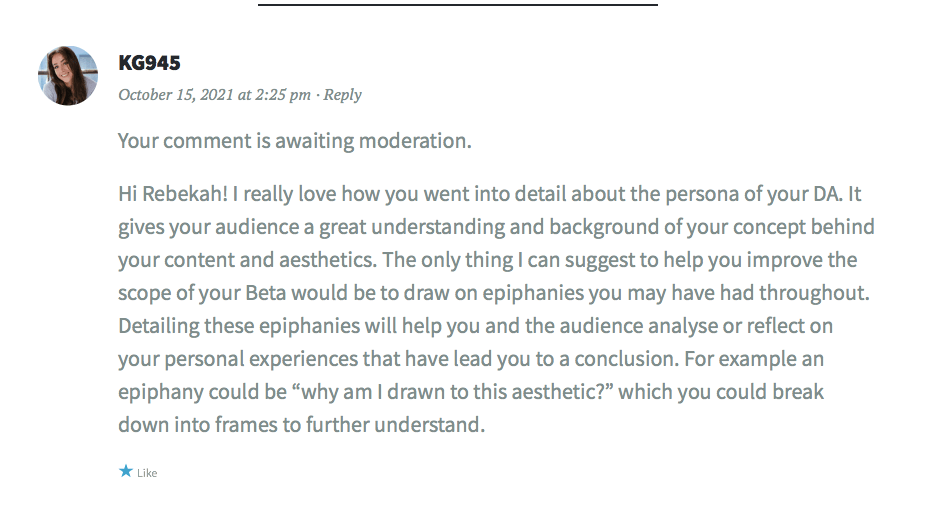
As you can see my feedback comment below I structured it with a friendly hi and went straight into detail about what I loved about her DA first. Detailing what grasped me first, her exceptional explanation of her persona of the digital artefact which I continued to congratulate in the way it explained her concept behind content and aesthetics. Furthermore I went on to suggest she include any epiphanies she might have come across through her research as my advice to expand the scope of her Beta. kBacking this suggestion up with an idea for an epiphany “Why am I drawn to this aesthetic?” to further reflect how this could help her audience see or explore her personal research experiences.
Last words
Reflecting on this learning process within these feedback tasks that we have to complete I have come to an amazing understanding and new found love for feedback because of the benefits a few reflective sentences on your work can hold. Everyone has the capacity for giving useful feedback and some people use it to more effect than others. The skills of giving and receiving feedback can be developed if attention is given to some of the attributes of the work or given in ways which enhance its contribution to learning. It is highly important in the way you give feedback though. I have received some feedback from a peer previously that made me feel attacked and judged because of the way they wrote their advice. This is exactly what you don’t want to do when giving feedback because the person will not take what you are saying into consideration fully and work on it because of the way it made them feel.
Some tips for appropriate, useful and good feedback from a Giving and receiving feedback guide:
include:
- Be realistic
- Be specific
- Be sensitive to their goals
- Be timely
- Be descriptive
- Be consciously non judgmental
- Be positive
- Be direct but kind
- Be diligent
References
UTS, 2002, “Giving and Receiving Feedback: A guide to the use of peers in self assessment”.

 Kyras blog