the good feedback

Reviewing peers’ work can be quite challenging as you can always see the positives first. The effort and time put into the work is always seen. Therefore finding something to critique is the hardest part. When structuring my comment I made sure I included something they did really well and something that they can work on or improve. 

Looking at Rebekahs digital artefact beta of her dogs she went above and beyond in terms of content creation. Making tik toks and instagram posts as mentioned in her Beta already! ( )

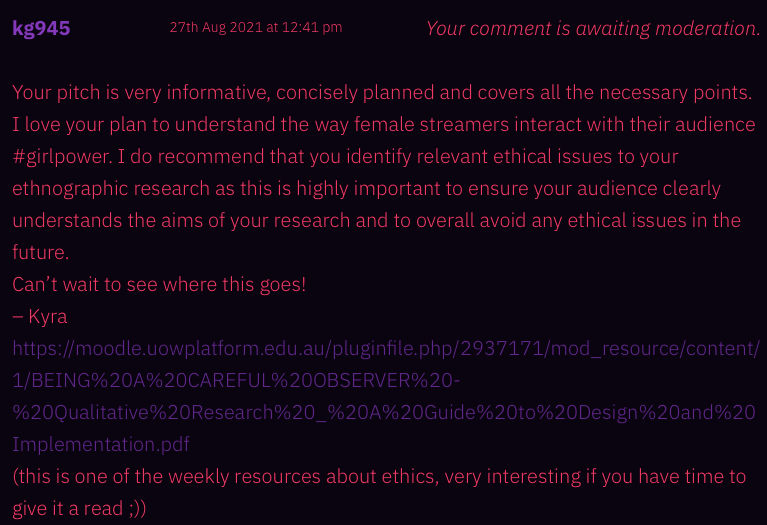
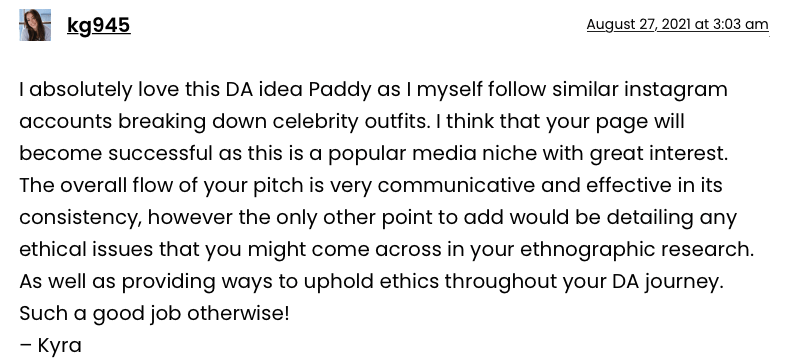
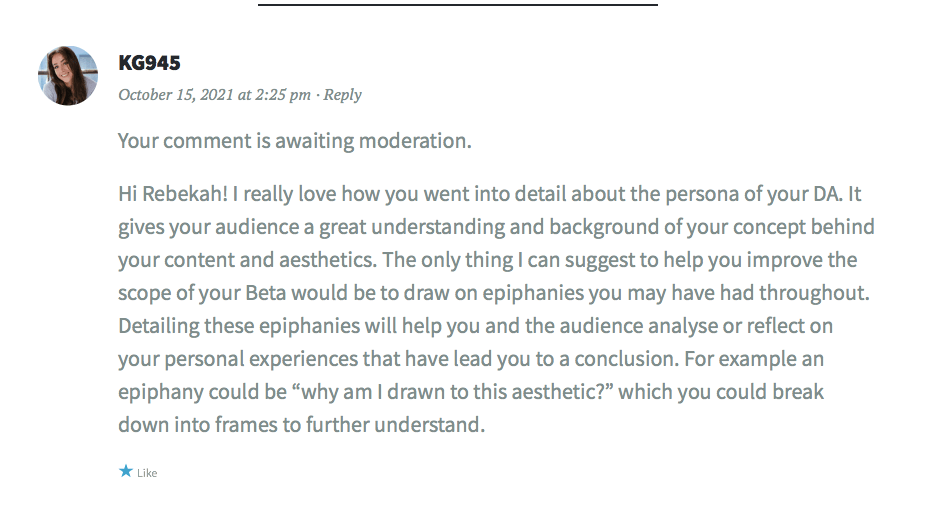
As you can see my feedback comment below I structured it with a friendly hi and went straight into detail about what I loved about  her DA first. Detailing what grasped me first, her exceptional explanation of her persona of the digital artefact which I continued to congratulate in the way it explained her concept behind content and aesthetics. Furthermore I went on to suggest she include any epiphanies she might have come across through her research as my advice to expand the scope of her Beta. kBacking this suggestion up with an idea for an epiphany “Why am I drawn to this aesthetic?” to further reflect how this could help her audience see or explore her personal research experiences. 
Last words

Reflecting on this learning process within these feedback tasks that we have to complete I have come to an amazing understanding and new found love for feedback because of the benefits a few reflective sentences on your work can hold. Everyone has the capacity for giving useful feedback and some people use it to more effect than others. The skills of giving and receiving feedback can be developed if attention is given to some of the attributes of the work or  given in ways which enhance its contribution to learning. It is highly important in the way you give feedback though. I have received some feedback from a peer previously that made me feel attacked and judged because of the way they wrote their advice. This is exactly what you don’t want to do when giving feedback because the person will not take what you are saying into consideration fully and work on it because of the way it made them feel. 

Some tips for appropriate, useful and good feedback from a Giving and receiving feedback guide:   

include:

  • Be realistic 
  • Be specific 
  • Be sensitive to their goals 
  • Be timely 
  • Be descriptive 
  • Be consciously non judgmental 
  • Be positive 
  • Be direct but  kind 
  • Be diligent 


References 

UTS,  2002, “Giving and Receiving Feedback: A guide to the use of peers in self assessment”. 
Learning in reviewing others work.

bcm241

audio and visual of feedback given

Throughout our research within our digital artefacts BCM241 students will conduct autoethnographic research. This entails understanding personal and non-personal engagement with others, of which we can explore, learn from and engage with. Therefore the process of engaging with my peers and reviewing their pitches enables a deeper understanding as well as a learning experience within my own work. 

“Students are more motivated to engage with and use feedback when the immediate utility of that feedback is clear”. (Moore & Tether, 2013 p197) This statement relates to the performance of our comments. The feedback that is given needs to be useful and informative of what can be done better, so that the receiver can act upon  and learn from the feedback given. 

Pitch 1

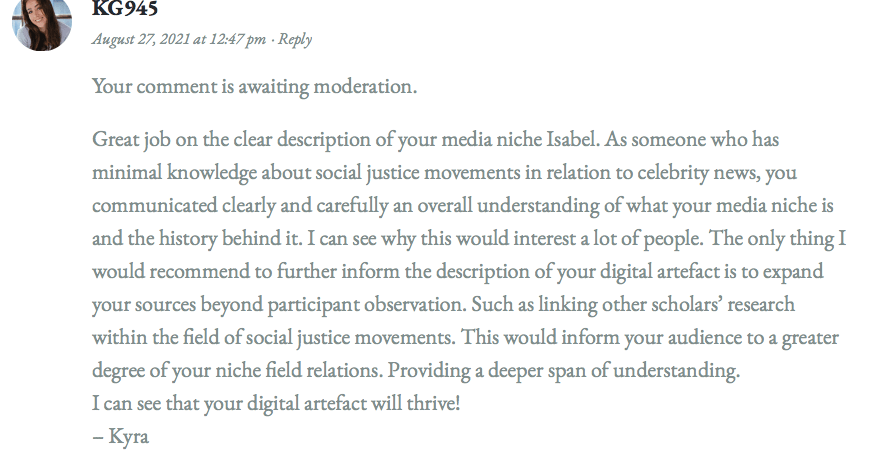
Isabel’s DA is interested in combining her passions of social justice movements and celebrity news stories through the use of tik tok videos. My engagement as a feedback member enables a reflection of what she did well and what can be added for improvement. Therefore my comment on her pitch  congratulated her on the great description of the media niche, however stating that adding more sources such as research articles on social justice movements could help expand her audience’s understanding of the specialty niche to a greater degree. 

https://justmundane101.wordpress.com

Pitch 2

Isabeau’s DA delves into how female video game streamers on twitch are treated within the industry. My feedback on this pitch was mostly positive as she concisely communicated every aspect of her DA. although not mentioning any ethical issues that can arise within ethnographic research. Reflecting on my comment now, I see that I could have informed her of the ethics to be aware of whilst conducting research in a public niche. Such key points being knowledge, truth and avoidance error. The researcher needs to promote truth in order to minimize error” (Resnik, 2020) 

Pitch 3

Lastly Paddy’s DA looks into cratings posts for his instagram page which break down outfits worn by celebrities within the hiphop and rap community. He too did a great job in communicating his DA however left out the importance of ethics related to the research of people. “In this [kind of] research, the participant is actively engaged in the pro- cess of production and interpretation of the visual image as data. What does this engagement entail and what are its consequences for the participant, the researcher and the research?” (Harley & Langdon, 2018)

these observations create a feedback loop and will help me improve on my own digital artefact and improve my persona by learning from others. 

References

Resnik, D 2020, ‘What is ethics in research and why is it important?’  National Institute of Environmental Health Sciences. 

 Harley, A & Langdon, J  2018, “ Ethics and Power in Visual Research Methods. The SAGE Handbook of Qualitative Research Ethics”, The SAGE handbook of Qualitative Research Ethics,  pp. 188 – 202.

Moore, C & Tether, S 2013, ‘Engaging students in peer review; Feedback as Learning,’ Issues in educational research, Vol. 23, No.2 , pp.197.

http://www.iier.org.au/iier23/moore.pdf 

FIELD SITE – DA

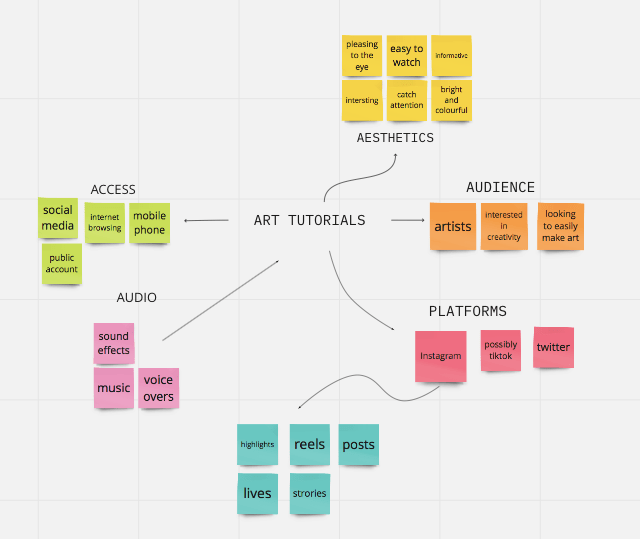
Since I’ve determined my media niche of art tutorials. I need to nominate a field site for my research project. What is a field site? A field site is not a singular physical or even online space. Its a large network of relations between human and non-human actors . (Moore, UOW lecture slides ) Field site research typically took place when the researcher could be physically present for a qualitative method of data collection, involving observations, interaction and an understanding of the people within that environment. However a field site differs within the online world. Advanced progression of digital media allows broader environments for studies. 

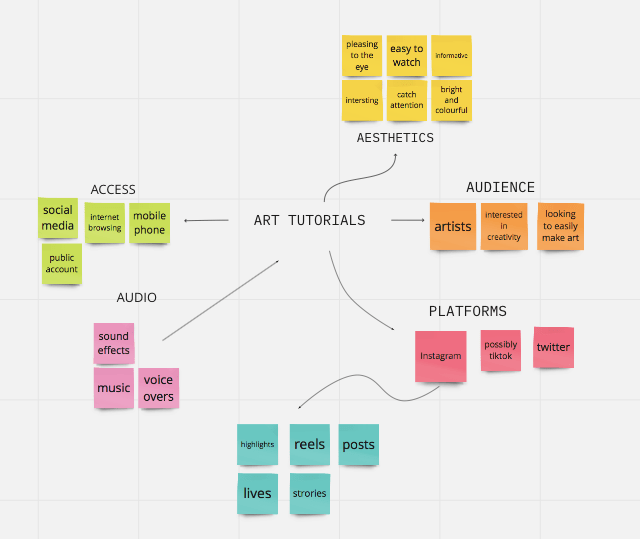
I can now expand and determine a field site specialised to my niche. My field site map links each media related content that my digital artefact will use throughout its development. “Mapping methods and social maps have been used by researchers as a means to document and analyse social networks and interactions as well as by those whom they study to gain an understanding of participant perspectives” (Powell, 2010)

field site map

My field site map above represents different ‘branches’ of my digital artefact medium. Depicting information that links to my media niche and its community. Overall helping create my persona. 

For example, looking at the Platforms branch, you will notice that it extends to Instagram, my main platform for the development and research. As well as Tiktok and Twitter. Although these other two platforms are not where my observation research will take place, they are still a part of my field site as they will be used for the promotion of my art tutorials. Sharing the videos on different sites will help me target a wider niche audience beyond just Instagram users, drawing them to my page. Branching from the sites, I outlined the field site uses of the platforms. To represent the relationship my content will have with my page in terms of delivery.

Im sure as my DA grows, adapts or changes my field site map may broaden.

References

Moore, C 2021, “BCM241 Media Ethnographies Lecture Slides”, UOW.

Powell, K  2021, “Making Sense of Place: Mapping as a Multisensory Research Method”. 

What is my media niche?

BCM241

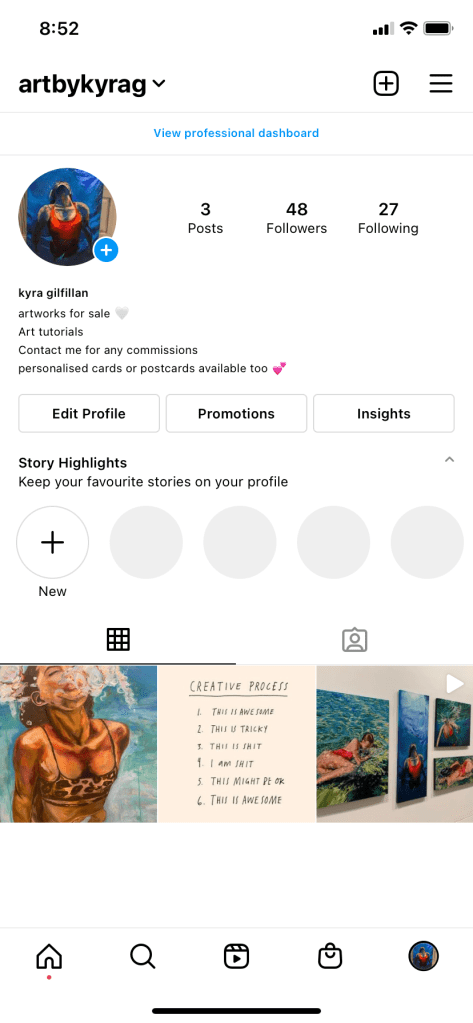
My media niche is going to be specifically art tutorials. And within my digital artefact it is going to be an Instagram account dedicated to all things creative. I want to create a page for inspiration for people who might not commonly take part in art. Providing a source of inspiration and a starting point of how the art process begins. This media platform will deliver practice and process tips on the media niche. Dedicated to the audience who are wanting to make art. 

Under the persona, artbykyrag my Media niche will include:

  • Tutorials using reels 

Simple and advanced 

Examples;   

Sketching out subjects on canvas 

Color blocking 

Concepts like line, form and shading with paint 

Mixing color palettes 

Landscape painting 

Portraits 

  • Tips and tricks using story highlights

Such as good products to use 

Beginners paint recommendations 

Priming products (different mediums) 

Affordable places to find canvas’

Media ecology emphasizes the environment in which communication and technologies operate and spread information. This relates to, in my case, Instagram. A platform that I will be using to spread my persona and deliver communication within creative tutorials. Furthermore the specialisation of art tutorials will use  communication and presence to reach further than just an Instagram audience,  therefore using twitter to create a presence outside of the media app Instagram, expanding my grasp on a niche audience.  Instagram is a great platform as it offers many different features which will be useful in my ethnographic research. Such as analytical insights, audience breakdowns available in graphs and charts, content reach and many sharing options such as stories, posts, highlights and reels. All of which can be highly beneficial in reaching my specific audience apart of my media niche.  Instagram is also a very well known platform home to millions of people, allowing a larger scope for my media niche and persona to be developed.  The ethnographic research that will take place within this media niche will enable an expansion of understanding under art tutorials and why they can be highly inspirational and useful for people starting out in the creative world. 

Lets get inspired to create art: Digital Artefact BCM241

Ethnography is typically understood as a methodology marked by explorative engagement”. (Hammersley & Atkinson, 2007) And this is exact;y what I will be doing within my niche. I shall be entering the field in which I can explore the social interactions, understand the interactions and reflect on the interactions of my online persona. 

To accurately conduct the autoethnographic research I will be following six steps; My field site and media niche have already been determined. Therefore the next steps I will take include participation and consequently observation within the art community, of which I will document and reflect on each experience as this journey proceeds. Epiphany identification will come next, reflecting my personal escapade. From this information gathered, background research on common experiences of scholars will help me communicate and interpret my findings. Lastly, analysis of my data collection will be necessary, providing comprehensible grounds to mediate and communicate the findings  to an audience beyond my niche. 

Observation will be my key research method however it is important to note  “Most observation is routine— largely unconscious and unsystematic. It is part of living, part of our commonsense interaction with the world. But just as casually conversing with someone differs from interviewing, so too does this routine observation differ from research observation” (Merriam & Tisdell, 2016). Therefore the use of observation as a research tool in my digital artifact, will begin with the issue of what to observe. In my case this is how art tutorials inspire and promote creative thinking and doing. Another systematic observation will be the relationship between the observer (myself) and the observed (my niche). These findings will contribute to the research development of my digital artefact.

Timeline for production schedule 

WEEK 6BACKGROUND RESEARCH + CONTENT CREATION
WEEK 7 OBSERVATION + CONTENT CREATION
WEEK 8 ANALYSIS OF CURRENT OBSERVATIONS AND UNDERSTANDINGS. DOCUMENT 
WEEK 9IDENTIFY ANY EPIPHANIES + CREATE CONTENT 
WEEK 10 MEDIATE AND COMMUNICATE OBSERVATIONS AND FINDINGS. BEGIN DRAFT
WEEK 11COMPLETE DRAFT
WEEK 12 MAKE ADJUSTMENTS IF NEEDED, THEN SUBMIT

MAP OF FIELD SITE

References

Dawson, C  2002 , “How to Carry Out Participant Observation, in Practical Research Methods,” A User-Friendly Guide to Mastering Research Techniques and Projects

Hammersley, M & Atkinson, P 2007, “Ethnography: Principles in practice”, no.4, Routledge.

Ladner, S 2014, “Ethical Ethnography. Practical Ethnography: A Guide to Doing Ethnography in the Private Sector”, Left Coast Press: CA.

Merriam, SB. and Tisdell, EJ 2016, “ Being a Careful Observer in Qualitative Research: A Guide to Design and Implementation”. 

DIGITAL ARTEFACT INSTAGRAM; @artbykyrag

BCM212 Research Project Pitch:

Research question: Are students more productive online at home or face to face on campus?

My intended topic for this research task is surrounded around productivity and the levels of productivity students encounter based on their working environment. Do students feel more productive at home in an online working space or face to face on campus in a class or library? 

First we must discuss the concept of productivity in order to relate it to my research and to understand the relevancy of this topic to uni students. As discussed by Tony Robbins the classic definition of productivity is “a way to measure efficiency’ more specifically “getting the results you want with less time and effort”. This can directly relate to why the environment in which we work in can increase or decrease productivity levels.

From my experience moving online in 2020 due to the covid pandemic has greatly affected the levels of productivity surrounding uni work. Although online education has its perks, making it possible for students across the globe to continue to obtain a quality education. Personally having to study and learn in my room a space previously dedicated to relaxing and leisure, full of distractions  makes me so unmotivated to put my head down and work. However on campus a dedicated property to education allowed me to be in a working zone therefore achieving so much more. I know many students feel the same way however some feel the opposite. Reason being why this topic is timely, relevant and achievable within our current surroundings. 

I set up a poll survey on twitter to gain an understanding of how BCM212 felt about their productivity levels based on the working environment. The following statistics were recorded after 3 days of the poll being up. 

I expected a mostly 50/50 response based on my previous understanding from fellow uni friends.  I was pleasantly surprised to see 60% of the small number of BCM candidates feel the same way I do. These results made me excited to find out more personally and from a larger group of  fellow BCM212 candidates why they feel the way they do and opened the door to my primary research data. 

Furthermore, as found in a comparative analysis article of student performance in an online versus face to face environment. Class room teaching is discussed as a well established instructional medium that has been refined over many centuries. Therefore holding numerous benefits not found in its online counterpart.(Xu and Jaggers, 2016)  I perceive these values could directly relate to productivity levels of students at Wollongong.

On the other hand a survey  by Mercer found that Ninety-four percent of 800 employers surveyed said that productivity was the same as or higher than it was before the pandemic, even with their employees working remotely. Although this survey was not conducted on university students the productivity levels online versus face to face have still been measured.  

Moreover this survey of 5000 workers across Australia, UK ,France and Germany found that productivity measured in time – 38% of candidates worked longer hours online, 19% said that they worked less and 43% said they worked around the same time. (Boddy, 2020) This is another piece of data indicating that productivity levels are highly individual and will depend on a number of factors. 

The data that I have read and analysed so far whilst researching my topic indicated that learning online or on campus definitely can affect the productivity of students. I think there is a lot of opportunity to delve deeper and understand why Wollongong students, specifically BCM212 may feel more productive depending on the learning environment. 

References;  

Maurer, R , 2020, ‘Study finds productivity not deterred by shift to remote work’, HR news, Viewed 20 March 2020

https://www.shrm.org/hr-today/news/hr-news/Pages/Study-Productivity-Shift-Remote-Work-COVID-Coronavirus.aspx

Boddy, N, 2020, ‘Its more productive to work from home’ , Financial Review, weblog post, viewed 20 March 2020

https://www.afr.com/work-and-careers/careers/it-s-more-productive-to-work-from-home-20200401-p54fwc

Robbins, T, na, ‘what is productivity, really?’ , Tony Robbins online blog, weblog post, Viewed 20 March 2020

Xu, D and Jaggars, S, 2016, ‘Performance gaps between online and face-to-face courses: differences across types of students and academic subject areas, ‘ J. Higher Education,  Pp. 633–659

https://www.frontiersin.org/articles/10.3389/fcomp.2019.00007/full#B37

Find me on Twitter: @GilfillanKyra

Digital Artefact:

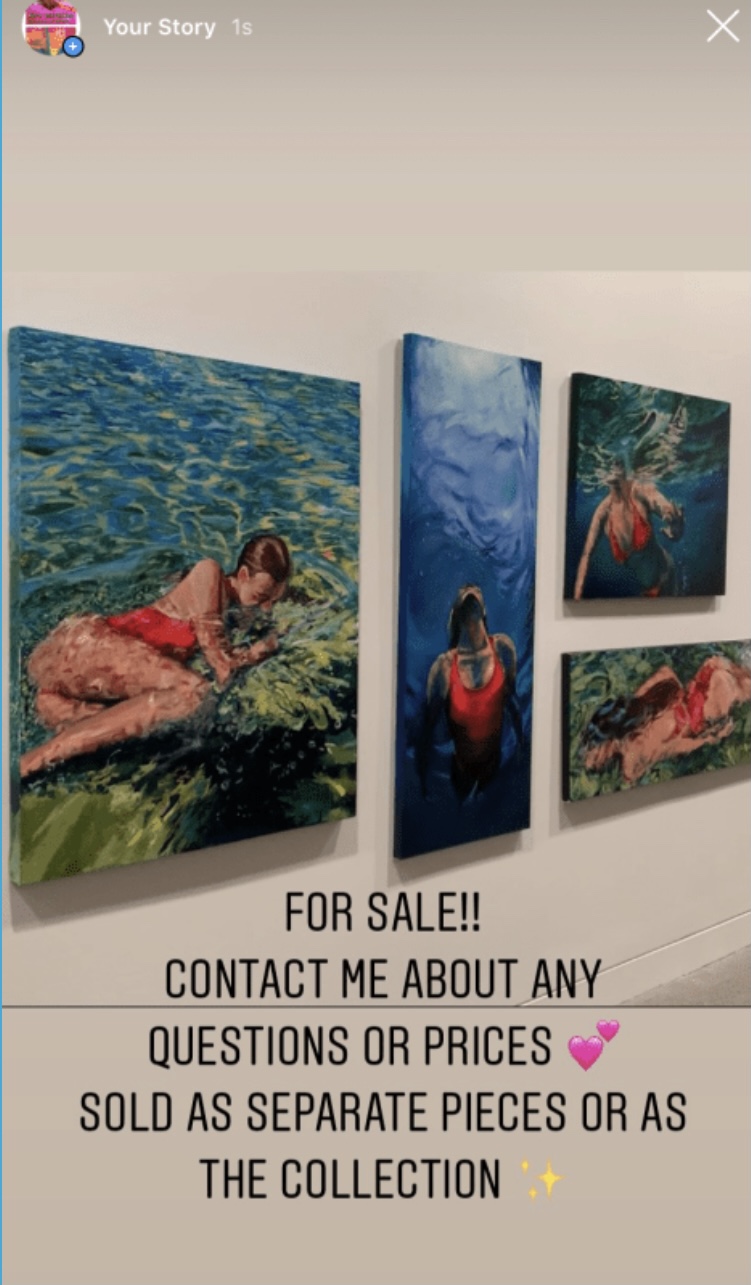
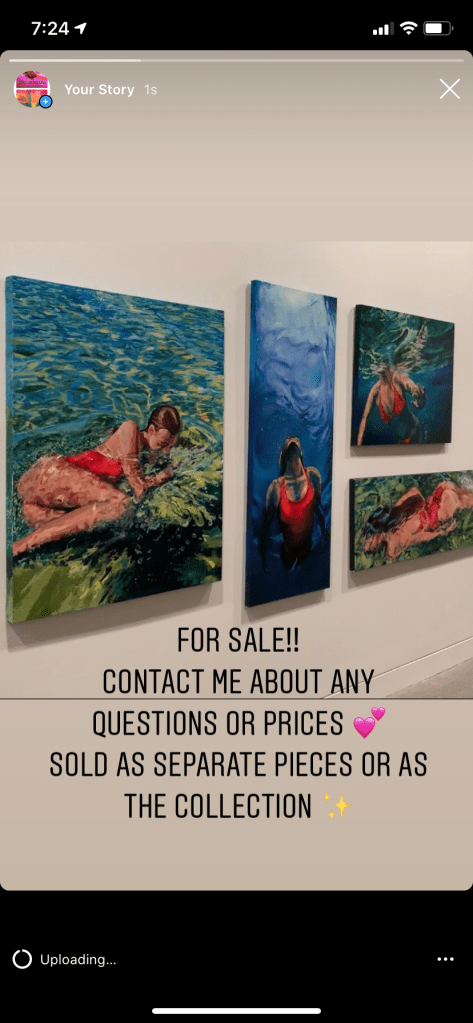
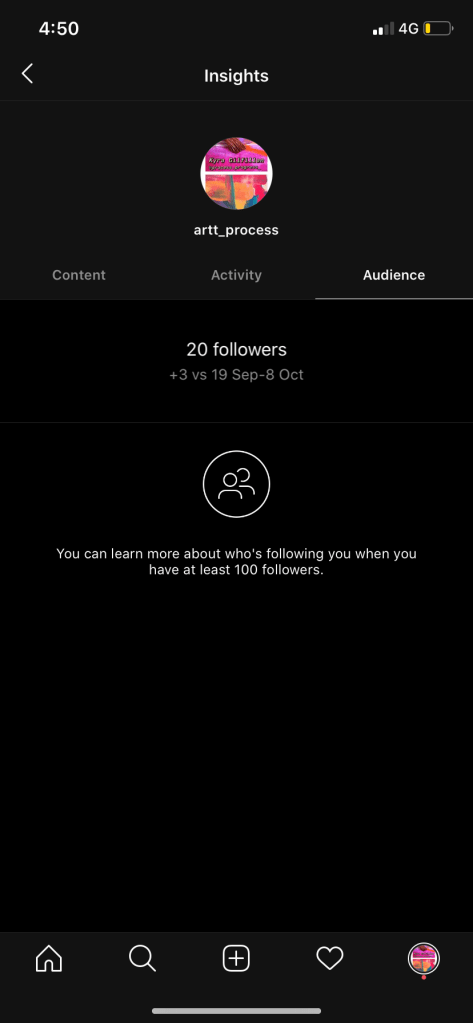
My digital artefact is a instagram art page called @artt_process. Intended to be a space of inspiration and learning whilst documenting my own artistic processes and journey. The page also acts as a gallery space to sell my completed artworks. I developed this project because after evaluating my hobbies and interest painting seemed like a sustainable option that I could enjoy whilst doing. I have also always been interested in the process of making art and the way it comes together at the end. I found it extremely helpful to see each step and relate it back to my own work as well as be inspired by it too. For these reasons I wanted to do exactly that for my audience. By observing similar tiktok and instagram account users as my potential audience and as research gave me insight to further develop my idea, based on what they seemed to enjoy. These audiences seemed to appreciate in-depth explanations about each step and what had been changed or done to the artwork as well as short sped up montages and videos documenting the process in a few seconds.

I developed my project by taking pictures and videos of my current artwork being worked on and explaining each step. As well as promoting my finished pieces. I have used my page as a hub for giving tips and tricks as well as recommending art supplies to further promote my page as a space for help on my audiences art journey.

At first in developing my project I did posts of previous artworks and marketed them for sale,  as well as documenting the work process I was currently working on at the time. I began to create stories  and save them in memory folders so that they could be viewed by future audiences. At this beginning stage my account had not gained many followers or made a large reach, however the minimal feedback I did receive was to begin creating and posting more content more frequently. This was typical feedback I received throughout the project as I really struggled with the #FIST methodology. The time and effort I needed to take to complete a single artwork was unsustainable to satisfy my audience because my works are often not tiny or fast in relation to the #FIST principle. This technical feedback is something I continued to work on throughout, to try and keep up with my audiences wants whilst managing other uni life. 

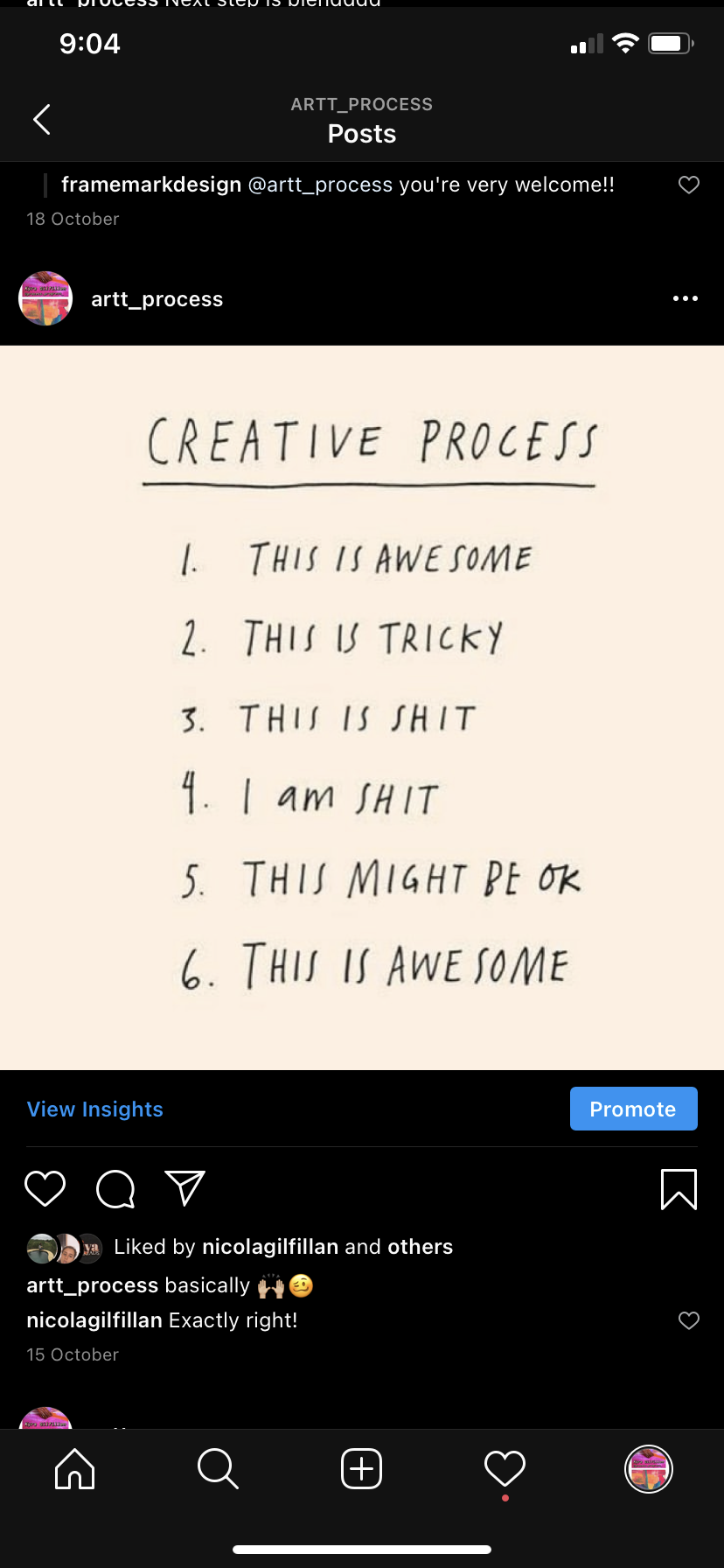
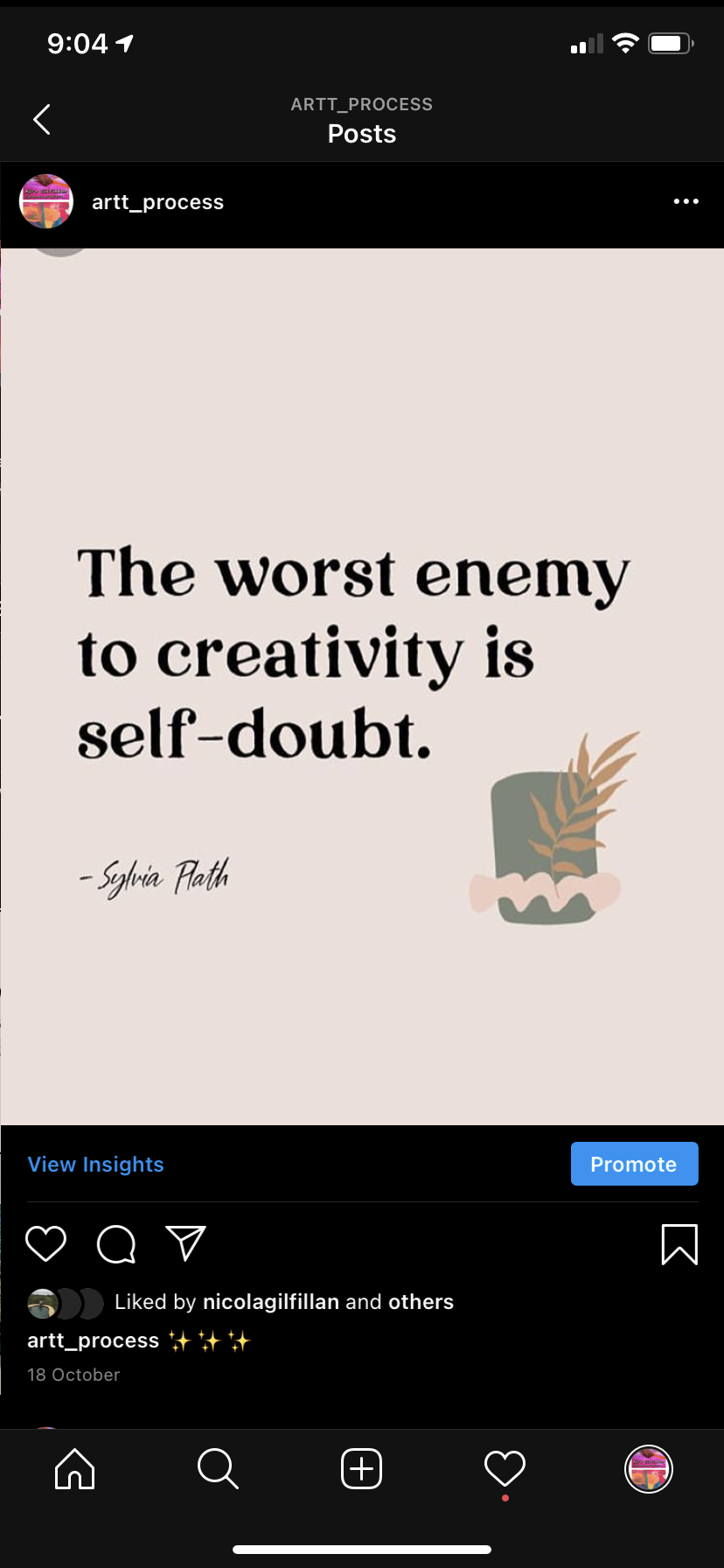
In the further development of my DA I began adding relatable arty quotes to try and connect with my audience better and relate to other users, whilst using it as a form of posting content more regularly. However I still was not creating enough content in terms of art for my audience and did not see a large change in followers. At this stage I also noticed that instagram was not sustainable to sell my art. I tried using Patreon as a pay wall however also did not find this successful in selling my works as whole purchases.

In conclusion, my digital artefact was a very interesting journey and I learnt alot about how to keep up with and promote an online presence. I was not highly successful in this, and did not gain a large following. However continuing the feedback loop and learning from my iterations, I will keep working on it for future BCM subjects.  

andddd.. another DA update :)

hey guys welcome back once again!

Since my last update for the BETA project, i have mostly been focusing on creating more content for my instagram page.  Because of this I am slowly gaining more followers on average a week, compared to previous weeks. Following my plan to have a posting schedule, I have been posting 2 photos of my progress on the piece I’m working on each week. One on Monday and one on Sunday. I have also been staying consistent with posting art based relatable quotes throughout my feed to try and further connect with my audience. 

Recently I have been receiving more comments on process and other art posts that have been really motivating to keep going. I reply to all the comments I receive in order to keep the feedback and engagement loop going.

My intention moving forward is to dedicate a whole day to content creating. That way I can have prepared posts more frequently. Relating to the #FIST principle again as this will help me develop multiple quick and easy pieces of art (or content) to share over a longer period of time. 

Regarding the idea of using Patreon as my main platform to monetize my artworks, I have completely scratched that. The  subscription is quite complicated. Basically in order to make money I would need a very large number of ‘subscribers’ of which contribute very little. As well as Patreon itself taking a small percentage of what you make yourself. Due to these reasons and other risks involved I have decided to move away from this and think of other ways to monetize my artworks.  I will continue to promote the sales of my pieces through my instagram page as well as Twitter whilst I try to think of new ideas to make sales on my pieces. 

BETA ;)

Welcome back, this is just another little update on my progress and iterations that i have experienced so far within my digital artefact.

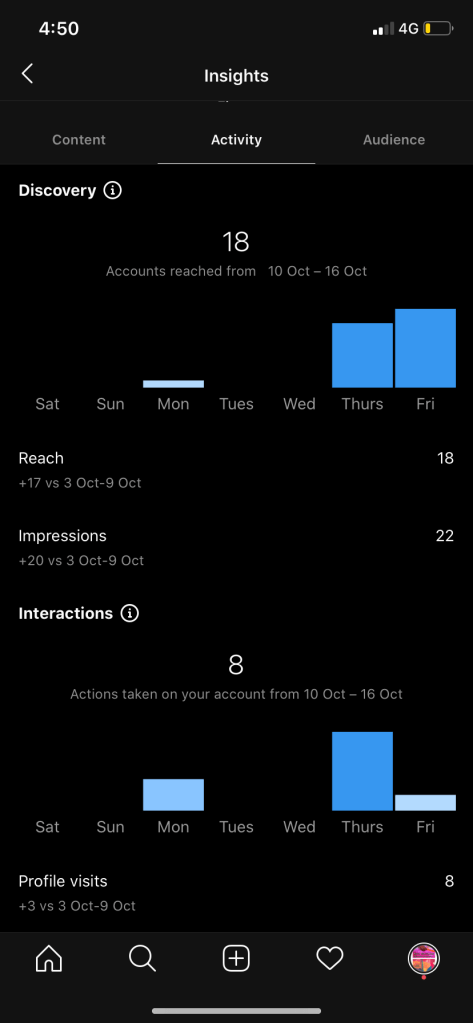
Arrt Process is my digital artefact in which I share my art journey, display and sell my pieces and give artistic tips and tricks whilst inspiring and offering help to anyone struggling or simply trying to make creative artistic pieces. I have also been adding quotes to try an relate to my audience on a more personal level. However I have really not found that instagram is working for me. I havent been gaining many followers or noticed a strong use of active followers interacting with my content. Aswell as feeling like instagram is not sustainable for selling my art either. Looking at my insights on instagram you can see that in the past week i have only made impressions on 22 accounts and reached 18 users without any interaction.

I was thinking of changing to a tik tok account to display the art making processes side of things, because it is easier to work with and make short 60 second videos using their tools to edit or add voice overs. In the hopes of making the content easier to find on the Tik Tok For You page and alot more interactive for my audience. However I then saw a tweet on our #BCM114 twitter feed with some advice for anyone who feels stuck on the platform that you are using. She said that if you love what you are doing but are stuck on the platform, simply try to move to a different one. This reminded me of some advice my tutor gave me from my pitch to put my art behind a paywall like Patreon and monetize the project in order to reach a more niche audience. Patreon is a membership platform that makes it easier for creators to get paid. Providing business tools and enabling fans (or patrons) to pay and support artists for their work. I have set up an account and will start to use this platform as my main source for selling my artworks. And will continue to use instagram as a base for my other art content.

I’m going to begin a posting schedule whereby I can plan a specific day to make content for my pages whilst painting. This will help me form a better routine as i have been struggling to find time to paint as it is very time consuming. I will also be adding more hashtags and start creating reels and try and collaborate with other accounts in the hopes of reaching more people.

Sit tight and bare with me on my DA journey whilst I perfect and continue to prototype my new direction. 😉

Follow my instagram account @artt_process